


 English
  Deutsch
  Français
  Italiano
  日本語
日本語 
Why Optimized Commercial Buildings Combine Wired and Wireless Technologies
Building automation systems have become a central component of modern commercial buildings, whether in new construction or retrofit projects. Key drivers include the need to reduce energy consumption and CO₂ emissions, comply with increasingly strict building and energy regulations, support ESG reporting, and create healthier, more attractive environments for occupants. In parallel, owners and investors are seeking to protect and increase asset value by ensuring buildings remain competitive, compliant, and future-ready.
Despite these drivers, market penetration remains relatively low. Only around 10–12% of commercial buildings in Europe and North America have fully integrated smart automation systems, while a further 40% operate with only basic automation. More than 80% of the European building stock was constructed in the last century, often without modern control systems. Changing work patterns, including hybrid working and a stronger focus on indoor air quality and wellbeing, further reinforce the need to upgrade existing buildings rather than rely solely on new developments.
Sensors as the Foundation of Smart Buildings
At the heart of every building automation system are sensors. These devices provide the real-time data required to monitor and optimize building performance, including occupancy, temperature, indoor air quality, lighting levels, and the status of windows and doors. Increasingly, sensor data is also combined with additional information such as weather forecasts, historical trends, and predicted occupancy to support advanced analytics and AI-based optimization.
In large commercial buildings, the number of sensors can range from thousands to tens of thousands. This scale raises a fundamental question for building owners, planners, and system integrators: which technologies are best suited to collect and transport this data reliably and efficiently?
Wired or Wireless? In Practice, Both
Rather than a binary choice, most successful projects use a combination of wired and wireless technologies. Each has strengths that make it well suited to specific applications.
Wired technologies are often preferred where high data throughput, deterministic communication, and long-term stability are required. They are commonly used for controllers, plant-level systems, and backbone infrastructure where cabling can be planned and installed efficiently.
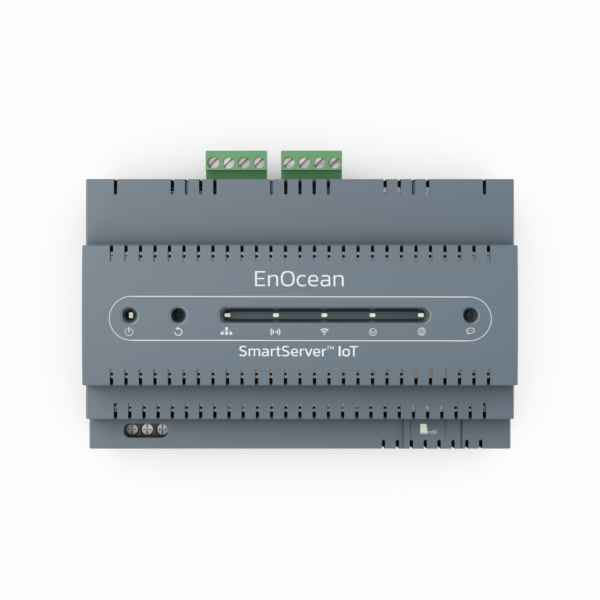
Wireless technologies offer flexibility, particularly in retrofit scenarios or where frequent layout changes are expected. In new build projects, wireless sensors can also reduce planning complexity and installation effort, while providing additional flexibility in cases where tenant layouts or space usage are not fully defined at the time of design and construction. Wireless sensors can be deployed quickly with minimal disruption to building occupants and fabric, making them suitable for upgrades, extensions, or temporary installations across a building’s lifecycle.
In commercial environments, maintenance considerations are critical. Battery replacement across large sensor networks can be costly, time-consuming, and environmentally undesirable. As a result, maintenance-free wireless solutions, such as energy-harvesting sensors, are increasingly considered where wireless communication is appropriate.
The Importance of Open Standards
Beyond the physical connection method, the choice of communication standard plays a decisive role in long-term system performance and flexibility. Open standards enable multi-vendor interoperability, reduce the risk of vendor lock-in, and benefit from broad industry support and continuous development. They also provide a structured framework for addressing cybersecurity and data protection requirements as regulations evolve.
BACnet: A Proven Wired Standard
BACnet, which will celebrate its 30th anniversary in 2026, is the most widely adopted open standard for commercial building automation. With a strong global ecosystem and widespread support among manufacturers, integrators, and consultants, BACnet provides a robust foundation for interoperable building automation systems. Its continued evolution reflects the changing requirements of modern buildings, including integration with higher-level management platforms and IT systems.
EnOcean: Wireless Where It Makes Sense
The EnOcean standard was developed specifically for building automation applications and is widely used for wireless sensors and switches. A defining characteristic of the EnOcean ecosystem is the availability of maintenance-free, energy-harvesting devices operating within a multi-vendor interoperable environment. These characteristics make EnOcean particularly suitable for both new build and retrofit projects, distributed sensing, and applications where wiring effort or ongoing battery maintenance would be impractical.
Combining Wired and Wireless in Real Buildings

This hybrid approach has been implemented in offices, airports, educational facilities, healthcare buildings, and retail environments over the past two decades. One prominent example of a large commercial building using a multi-protocol wired and wireless architecture is The Squaire at Frankfurt Airport in Germany. As one of Europe’s largest office and commercial buildings, The Squaire combines BACnet-based wired automation with more than 20,000 EnOcean wireless sensors, demonstrating how both technologies can coexist at scale within a single, complex building environment.
Extending a BACnet system with wireless sensors is typically achieved using gateways or bridges that translate between standards while maintaining interoperability. A wide range of such gateways is available from multiple suppliers, enabling scalable and future-proof system architectures.
Conclusion
The question for smart building projects is no longer whether to choose wired or wireless technologies, but how to combine them effectively. By selecting open standards and aligning technology choices with specific application requirements, building owners and system integrators can create resilient, flexible, and sustainable automation systems. In this context, wired and wireless technologies are not competing alternatives, but complementary tools supporting the shared goal of better-performing buildings.
Authors

Graham Martin
Chairman & CEO | EnOcean Alliance
graham.martin@enocean.com | www.enocean-alliance.org

Michaela Brestakova
Global Marketing Executive | EnOcean Alliance
hello@mickeyblank.com | www.enocean-alliance.org